
AI Governance in Marketing: Real-Time Decision Logging Explained
As marketers adopt AI for ads, personalization, and content automation, governance moves from a legal checkbox to an operational necessity. Real-time decision logging — capturing what an AI system decided, why, and how it acted at the moment of inference — is central to accountable, transparent, and high-performing marketing operations. This guide explains what real-time decision logging is, why it matters, and how marketing leaders and teams can implement it end-to-end.
What is real-time decision logging?
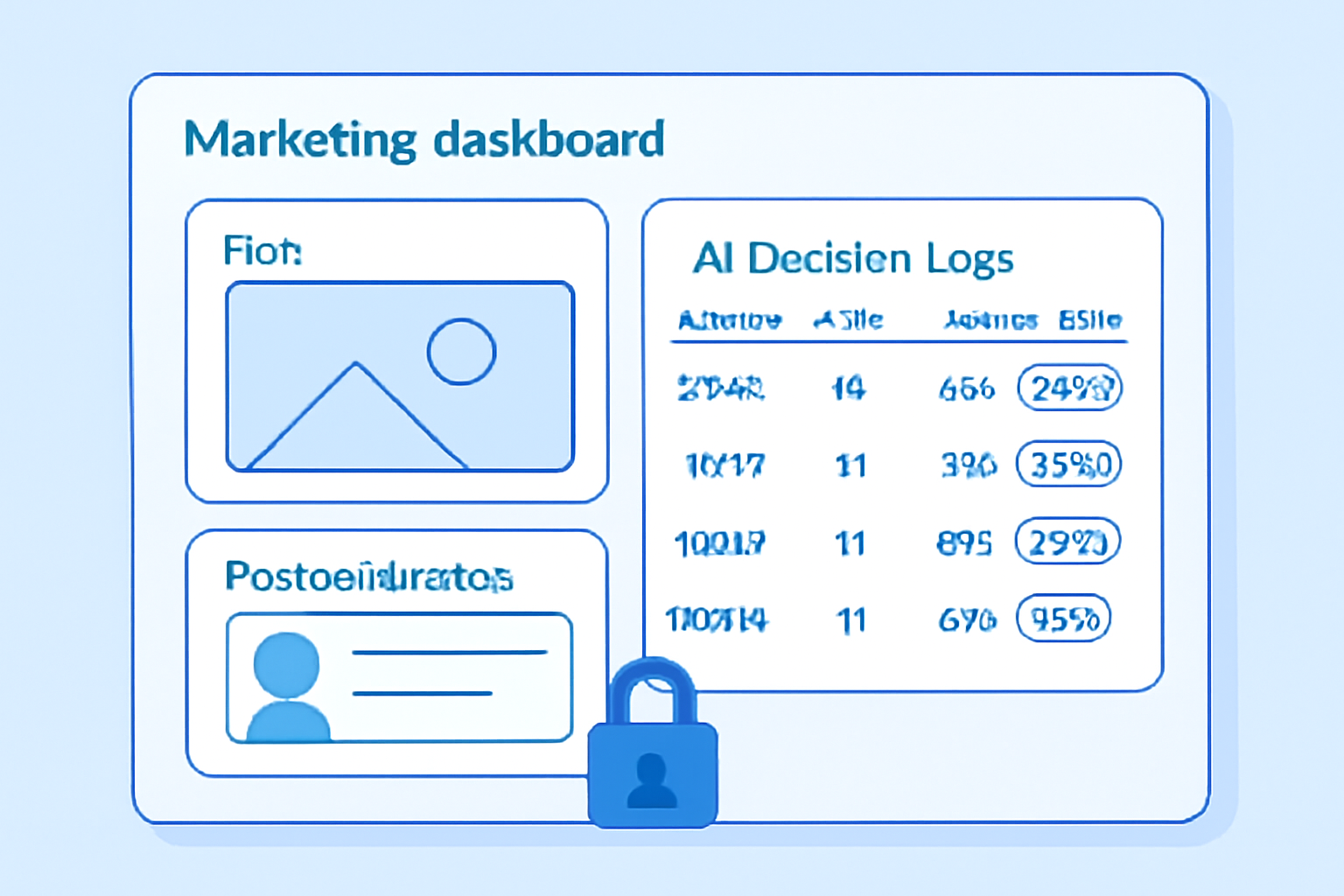
Real-time decision logging records each decision an AI system makes as it happens. For marketing, that includes which creative or ad variant was selected, recommended product lists, personalized page content, or generated copy. Logs typically include input signals, model version, confidence scores, timing, downstream action, and any policy or safety flags.
Why it matters for marketing teams
1. Compliance and auditability
Regulations and internal policies require traceability. Logs provide a timestamped trail to explain why a particular message or recommendation was served.
2. Transparency and trust
Decision logs enable clear explanations for stakeholders and customers, reducing brand risk when AI outputs surprise audiences.
3. Attribution and performance analysis
Linking decisions to conversions or engagement lets teams measure model impact, run valid A/B tests, and attribute outcomes to the right algorithms and creative elements.
4. Operational monitoring and debugging
Real-time logs surface issues like model drift, latency spikes, or unexpected outputs so teams can act quickly and maintain campaign performance.
End-to-end implementation checklist
Follow this step-by-step checklist to set up real-time decision logging for marketing AI systems.
1. Define scope and objectives
- Decide which AI decisions to log (ads served, personalization choices, generated content).
- Set objectives: compliance, attribution, performance tuning, or safety monitoring.
2. Specify required fields and schema
- Minimum fields: timestamp, user/session ID (hashed if needed), input context, model ID/version, output/decision, confidence score, downstream action, latency, policy flags.
- Include campaign and creative identifiers for marketing attribution.
3. Instrument inference and edge layers
- Log at the point of decision — in the model serving layer or API gateway — to capture true production behavior and latency.
- Use middleware or SDKs to inject logging consistently across channels.
4. Stream, store, and secure logs
- Use event streaming to move logs reliably to storage (e.g., Kafka, Kinesis, Pub/Sub).
- Store immutable logs in cost-effective, queryable storage (cloud object storage, data warehouse).
- Apply encryption, access controls, and masking to protect PII.
5. Link logs to analytics and attribution systems
- Join decision logs with conversion events in your analytics stack using consistent user/session keys and timestamps.
- Ensure time-synchronization across systems for accurate attribution.
6. Monitor, alert, and visualize
- Set dashboards and alerts for key metrics (latency, confidence distribution, drift indicators, policy-trigger rates).
- Automate retraining or rollbacks based on monitored signals.
7. Governance, retention, and audit processes
- Define retention windows and deletion procedures to comply with privacy rules.
- Document logging policies and auditing workflows for internal and external reviews.
Tool recommendations
Choose tools that fit your stack and scale. Examples by function:
- Event streaming: Kafka, AWS Kinesis, Google Pub/Sub
- Storage and analytics: Cloud object storage, BigQuery, Snowflake
- Monitoring and model observability: WhyLabs, Arize, Fiddler
- Logging and search: Elasticsearch, Splunk, Datadog
- Instrumentation: OpenTelemetry, custom SDKs
Key metrics to track
- Decision latency — affects user experience and ad auctions
- Confidence calibration and distribution — identify overconfident or low-confidence outputs
- Outcome attribution — conversion lift and ROI per model/version
- Drift metrics — feature and prediction drift over time
- Policy flag rate — content-safety or compliance triggers
- Error and retry rates — system reliability indicators
Practical use cases
Ads: Which creative drove the conversion?
Log the selected ad creative, bidding decision, user cohort, model version, and timestamp. Later, join logs with conversion events to measure which creatives and model strategies generated the most revenue and attribute spend correctly.
Personalization: Why did this user see that feed?
Capture user signals, segment tags, model output, and ranking score. If a user complains or churns, you can trace back exactly which signals and model profiles produced that experience and adjust rules or retrain models.
Content automation: Who approved generated content?
Record prompt, model version, generated copy, post-edit actions, and compliance flags. This enables audits showing whether content passed safety checks and who approved final assets.
Implementation pitfalls to avoid
- Logging inconsistent schemas across environments — standardize early.
- Over-logging PII — mask or hash identifiers to reduce risk.
- Ignoring retention and access controls — logs are sensitive and must be governed.
- Not linking logs to outcome events — decision logs without conversion linkage limit usefulness.
FAQs
How much data should we log?
Log the minimum fields required to meet your compliance, attribution, and monitoring goals. Excessive logging can raise costs and privacy risk; choose a balanced, documented schema.
Do we need real-time storage for logs?
Event streaming with durable storage is recommended. You can write logs in real time and batch-process them for analytics. Real-time alerts and short-term monitoring benefit from streaming pipelines.
How do we handle user privacy?
Hash or tokenize user identifiers, avoid storing raw PII in logs, enforce strict access controls, and adhere to retention/deletion policies aligned with privacy regulations.
Can small teams implement this?
Yes. Start with a limited scope (e.g., one campaign or model), use managed services, and scale as governance needs grow.
Conclusion
Real-time decision logging is a practical cornerstone of AI governance in marketing. It supports compliance, boosts transparency, improves attribution, and helps teams keep models safe and performant. Implementing a well-structured logging pipeline — with clear schemas, secure storage, observability, and linkage to outcomes — turns AI from a black box into an accountable asset for businesses, brands, startups, eCommerce companies, service providers, and marketing teams.
Ready to put governance into practice? The Next Zeros helps marketing teams design and implement decision-logging pipelines, select tools, and integrate logs with analytics for measurable results. Contact us to build an AI governance roadmap tailored to your marketing stack.