
Online Marketing Trends 2026: Why Trust-Based Marketing Is More Valuable Than Traffic
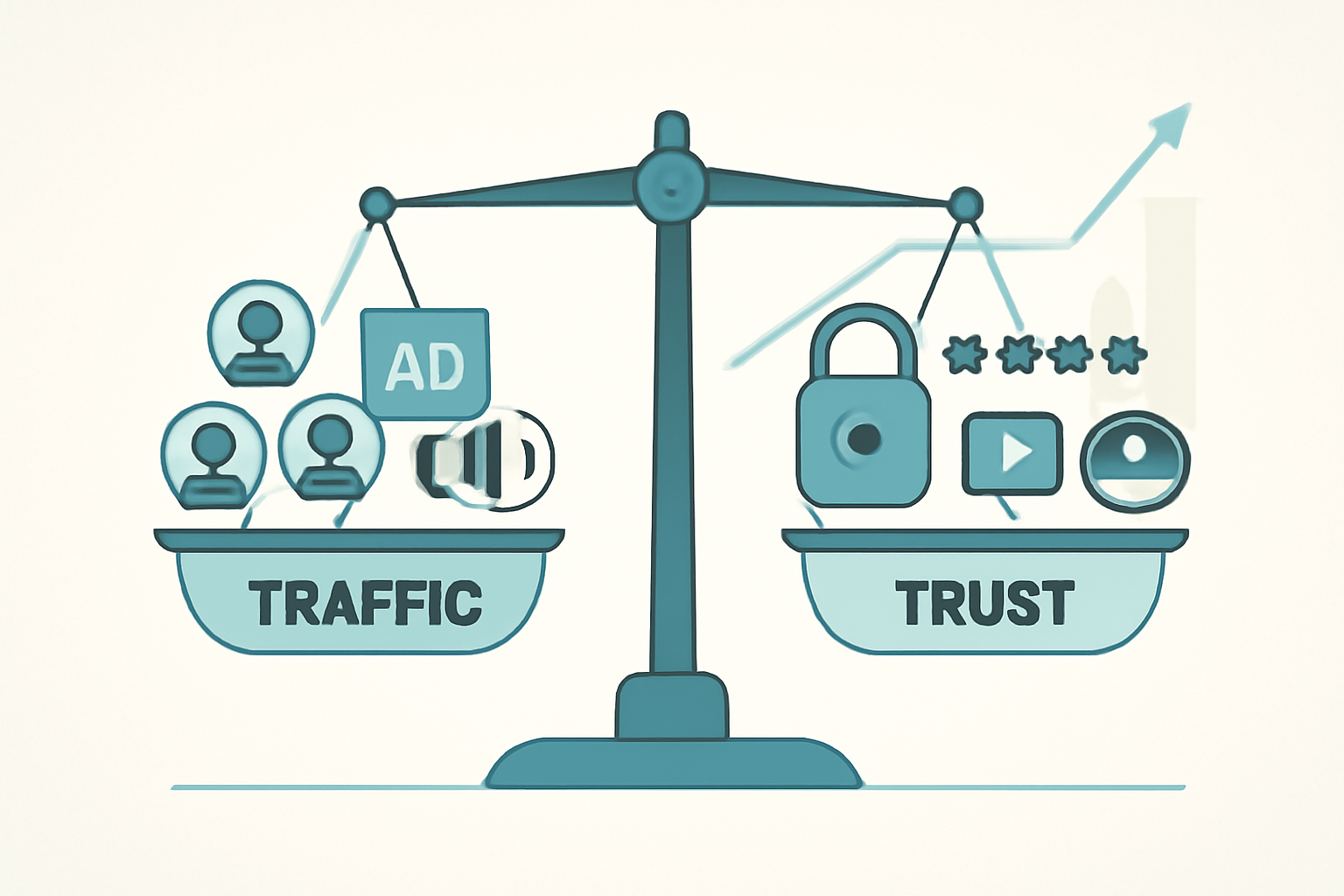
In 2026, marketers are reallocating budgets and attention from pure traffic acquisition to building durable relationships. The web is flooded with AI-generated content, privacy rules and the end of easy third‑party tracking have made clicks cheaper but less valuable. For businesses that want sustainable growth—brands, startups, eCommerce companies, service providers, and B2B firms—the new currency is trust. This guide explains how to shift your strategy to trust-based marketing with concrete steps you can take today.
Why trust outranks traffic in 2026
Traffic numbers still matter, but quality has become more important than quantity. Several forces are driving the shift:
- Privacy-first regulation and browser changes reduce the reliability of third‑party signals, making first‑party relationships more valuable.
- AI content saturation makes it harder to stand out on volume alone—users prioritize credibility and usefulness.
- Platforms and search engines increasingly reward signals tied to expertise, experience, authoritativeness, and trustworthiness.
In short: converting visitors into loyal customers is a more predictable path to ROI than continually inflating visitor counts.
Core elements of a trust-based marketing strategy
1. Content strategy grounded in E-E-A-T
E-E-A-T (Experience, Expertise, Authoritativeness, Trustworthiness) guides content that builds credibility. Actions:
- Create content with identifiable authorship—bios that show real expertise and real experience solving problems.
- Prioritize long‑form, actionable resources (how‑tos, case studies, troubleshooting guides) over thin listicles.
- Use primary research and customer examples to demonstrate real-world results.
Example: A B2B SaaS company publishes a case study showing implementation timelines, obstacles, and measurable outcomes with named client quotes and a downloadable checklist—this signals experience and helps convert.
2. First‑party data & privacy-forward relationships
As third‑party cookies fade, first‑party data becomes the backbone of personalization and measurement. Actions:
- Collect minimal, high-value data with transparent consent (email, product preferences, purchase intent).
- Use progressive profiling to enrich profiles over time rather than asking for everything at once.
- Leverage CRM and CDP systems to connect touchpoints and create a single customer view.
Example: An eCommerce company asks for size and style preferences at signup, then uses product page views and past purchases to tailor emails and on-site recommendations.
3. Social proof, reviews, and user-generated content
Trust scales when other people vouch for you. Actions:
- Make reviews and testimonials prominent across your site and in ad creative.
- Encourage verified user-generated content (photos, video unboxings) and highlight the best examples.
- Respond publicly to both positive and negative reviews to show accountability.
Example: A service provider showcases before/after project galleries with client testimonials and a short interview clip from the client describing the ROI.
4. UX, transparency, and fast, secure experiences
Trust is reinforced by a smooth user experience and clear policies. Actions:
- Optimize load times, mobile performance, and accessibility to reduce friction.
- Be transparent about pricing, returns, and data usage—place policies where users expect them.
- Use secure badges, up-to-date privacy notices, and clear consent flows.
Example: A SaaS pricing page shows exact tiers, a calculator for cost estimation, and a clear link to support and refund terms—reducing hesitation at decision time.
5. Retention-first lifecycle marketing
Acquiring a customer is expensive; retaining one multiplies value. Actions:
- Design onboarding that delivers immediate value (quick wins within first 7 days).
- Use lifecycle emails/SMS and in-app messages to nurture usage and renewal activity.
- Measure churn drivers with cohorts and address the top behavioral breakpoints.
Example: A subscription brand sends a personalized onboarding series that highlights product hacks, resulting in higher engagement and lower churn.
6. Conversion optimization and trust signals
Optimization moves beyond A/B testing headlines—focus on signals that reduce perceived risk. Actions:
- Test proof elements like money-back guarantees, free trials, and explicit outcomes on landing pages.
- Run qualitative research (user interviews, session recordings) to uncover trust blockers.
- Use milestone nudges (e.g., “90% of customers see results within 30 days”) only when verifiable.
7. Align paid and organic around trust
Paid channels can amplify trust signals generated by organic work. Actions:
- Direct paid traffic to high‑trust pages (case studies, comparison pages, FAQ pages) rather than generic homepages.
- Use remarketing creative that references prior interactions and trust assets (reviews, awards).
- Share learnings across teams—use paid tests to validate messaging that can scale in organic content.
How to measure trust
Trust is intangible but measurable via behavioral and qualitative metrics:
- Engagement on trust content (time on case studies, repeat visits to support pages).
- Conversion quality (higher LTV, lower refund rates, higher average order value).
- Retention metrics (churn, repeat purchase rate), NPS and review sentiment analysis.
Use cohorts and lifecycle analysis to link trust-building activities to long-term revenue impact.
Quick implementation roadmap (90 days)
- Audit existing content, reviews, and landing pages for E-E-A-T signals and update authorship and sourcing.
- Set up or refine first‑party data capture and consent mechanisms; integrate with CRM.
- Publish 2 high-value trust assets (detailed case study + product ROI calculator) and promote through paid and organic channels.
- Launch an onboarding improvement sprint and A/B test a trust element on the highest-traffic landing page.
- Set KPIs for retention and repeat business to evaluate progress.
FAQs
Q: What is trust-based marketing?
A: Trust-based marketing prioritizes building credible, long-term relationships over short-term traffic wins. It focuses on transparent practices, expert content, social proof, data privacy, and retention.
Q: How quickly will trust investments pay off?
A: Some benefits—like higher conversion rates from improved pages—can appear within weeks. Full ROI from retention and reputation-building typically unfolds over months to a year.
Q: Can paid ads still work in a trust-first approach?
A: Yes. Paid ads should drive users to trust-enhancing assets and reinforce credibility with review snippets, case studies, and transparent offers.
Conclusion
In 2026, marketing success depends less on chasing raw traffic and more on cultivating trust that converts and retains customers. By embracing E-E-A-T content, first‑party data, visible social proof, frictionless UX, and aligned paid+organic strategies, businesses can create predictable, sustainable growth. Start small, measure the right signals, and prioritize long-term relationships over short-term spikes.
Ready to shift from traffic hunting to trust-based marketing? The Next Zeros helps brands build and implement strategies that increase lifetime value and reduce churn. Contact us for a trust audit and a 90‑day action plan tailored to your business.