

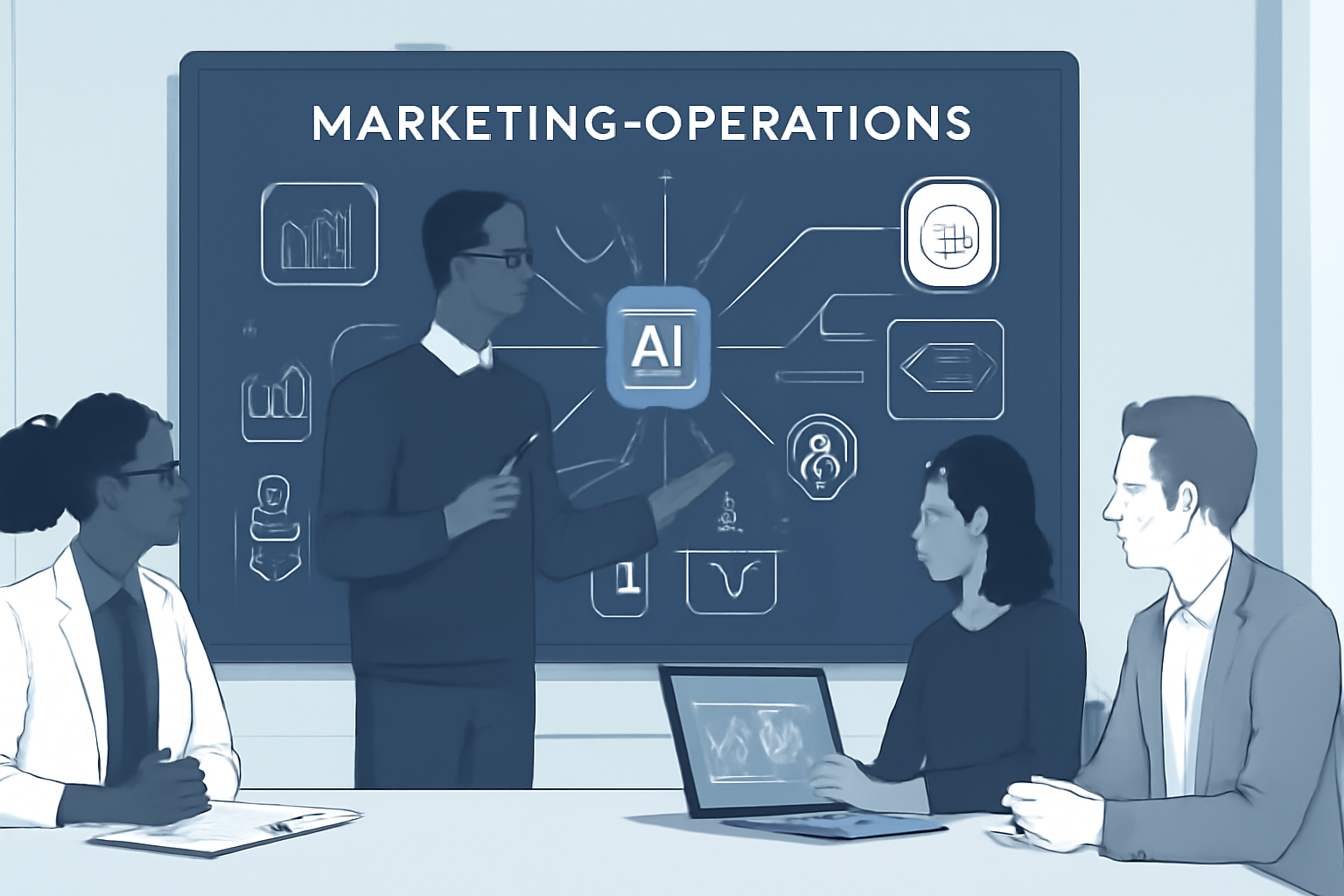
AI-Powered Marketing Systems: A Practical Step-by-Step Guide for 2026
AI-powered marketing systems are no longer experimental — they are business-critical. For marketing leaders, growth teams, and founders in 2026, the challenge is less about whether to adopt AI and more about how to implement, integrate, and scale systems that are reliable, measurable, and compliant. This guide provides a practical, step-by-step approach you can apply to startups, eCommerce companies, service providers, B2B brands, and agencies.
Step 1 — Define clear business goals and success metrics
Start with outcomes, not tools. Define 2–3 primary goals AI will support, such as increasing qualified leads by X%, boosting average order value, improving retention, or reducing customer acquisition cost. For each goal, set measurable KPIs and a baseline so you can evaluate AI’s impact.
Example
An eCommerce brand might set: increase repeat purchase rate by 15% and lift email revenue by 25% within 12 months. KPIs: repeat purchase rate, email revenue, and churn rate.
Step 2 — Pick the right AI tools and vendors
Match tools to workflow needs rather than features alone. Consider the following categories:
- Content generation and personalization (for ad copy, emails, landing pages)
- Customer data platforms (CDPs) with AI segmentation and activation
- Predictive analytics for lead scoring and churn forecasting
- Conversational AI for support and lead qualification
- Automation platforms for orchestration and campaign execution
Evaluate vendors on data access (APIs, connectors), model explainability, on-premise/edge options if needed, and integration capabilities with existing stacks (CRM, analytics, ad platforms).
Practical selection checklist
- Does it connect to your data sources securely?
- Can you export models or insights for audit and portability?
- Is the vendor transparent about training data and biases?
- Are SLAs and support aligned with your growth cadence?
Step 3 — Design workflows and integrate data
AI output is only as good as input. Build a data-first integration plan:
- Centralize customer data in a CDP or data warehouse.
- Define a single customer identifier across systems.
- Standardize event naming and attribute definitions.
- Create ETL processes for real-time and batch needs.
Map AI workflows to marketing operations. Example: lead scoring model in the warehouse → push top leads to CRM → trigger personalized nurture sequence via marketing automation → route hot leads to SDRs.
Example
A B2B company uses behavioral signals (page visits, content downloads) in a CDP to feed a predictive scoring model. High-scoring leads are automatically enrolled in a tailored nurture flow and assigned to sales when they reach a sales-ready threshold.
Step 4 — Implement measurement and attribution
Establish measurement frameworks before launch. Use incrementality testing, holdout groups, and A/B tests to isolate AI-driven impact from seasonality or other investments.
Key measurement tactics
- Holdout test: keep a control cohort without AI personalization to measure uplift.
- Attribution layering: combine first-touch, last-touch, and multi-touch models with experimental data.
- Model monitoring: track drift in input distributions and performance decay.
Track model-level KPIs (precision, recall, calibration) and business KPIs (conversion rate, LTV, CAC). Review monthly and set automated alerts for performance degradation.
Step 5 — Address compliance, privacy, and ethics
In 2026, privacy regulation and customer expectations demand proactive governance. Build compliance into your architecture:
- Minimize data: store only what’s necessary for models.
- Implement consent management and honor opt-outs across systems.
- Document model sources, features, and decision logic for audits.
- Run bias checks on models that affect pricing, eligibility, or offers.
Engage legal and security teams early. Maintain records for data lineage and consent history to respond quickly to subject access requests.
Step 6 — Scale with governance and cross-functional teams
Scaling AI requires operations and governance, not just engineers. Set up a cross-functional squad with marketing, data engineering, analytics, product, and legal representatives. Define clear SLAs for model retraining, monitoring, and rollback.
Operational playbook items
- Model versioning and deployment checklist
- Incident response plan for model failures
- Change logs for feature updates and data source changes
Document repeatable templates for audience creation, creative variants, and reporting to reduce time-to-market for new AI use cases.
Common pitfalls and how to avoid them
- Over-automation: Keep human oversight on strategic decisions and creative review.
- Poor data hygiene: Invest early in cleaning, deduplication, and canonicalization.
- Ignoring explainability: Favor models and vendors that provide interpretable outputs for marketing and compliance teams.
- Underestimating change management: Train teams and document new workflows to drive adoption.
Real-world examples
Example 1 — eCommerce personalization: A retail brand used session-level signals to power a real-time recommendation engine. By combining purchase history and on-site behavior, the brand increased average order value and reduced cart abandonment through targeted offers delivered via email and onsite widgets.
Example 2 — B2B lead prioritization: A SaaS company used predictive propensity models to flag accounts most likely to convert. Sales focused outreach on high-propensity accounts and shortened sales cycles by prioritizing demos for warm accounts.
FAQs
What is the first AI use case I should deploy?
Start with low-risk, high-impact use cases like personalized email subject lines, product recommendations, or lead scoring. These deliver measurable results and are easier to measure with A/B tests.
How much data do I need?
There’s no one-size-fits-all answer. Some personalization and classification tasks work with thousands of records; others need millions. Focus on quality, consistent identifiers, and capturing the right behavioral signals.
How do I keep models from becoming biased?
Assess training data for skewed representation, test outputs across demographic and behavioral cohorts, and include fairness checks in model monitoring. When in doubt, include a human review step for sensitive decisions.
Can small teams use AI effectively?
Yes. Small teams can adopt prebuilt models and managed services, use a simple CDP, and focus on a narrow set of measurable use cases. Start small and expand as you demonstrate ROI.
Conclusion
AI-powered marketing systems offer major performance gains when implemented with discipline: define goals, choose tools that fit your stack, centralize and clean data, measure with experiments, and maintain strong governance. With the right roadmap, businesses of every size can scale AI-driven personalization and growth safely and effectively.
Call to action
Need help implementing AI-powered marketing systems? The Next Zeros helps marketing teams and brands design, integrate, and scale AI-driven workflows that deliver measurable growth. Contact our team to build a customized roadmap and pilot your first AI use case.