

The Complete Playbook for Multi-Location Local SEO
Managing local search presence for dozens or thousands of locations requires more than NAP consistency. Today’s multi-location local SEO depends on clean entity modeling, scalable Google Business Profile (GBP) operations, AI-assisted optimization, localized content architecture, and systems to measure performance. This guide gives a practical, step-by-step playbook for businesses, brands, startups, eCommerce companies, service providers, and marketing teams.
How Google evaluates multiple locations (quick primer)
Relevance
Google treats each storefront as an entity. Relevance is about whether a specific location matches the search intent. For multi-location brands, this requires clear categories, explicit services per location, and local landing pages that reflect real capabilities.
Distance
Proximity to the user or the location modifier in the search is non-negotiable. You cannot optimize a location’s physical distance, so focus on other signals when proximity is weak.
Prominence
Prominence is local reputation — reviews, local links, consistent directory data, and real-world visibility. Local-level prominence often beats a generic national footprint for pack visibility.
Step-by-step playbook for multi-location local SEO
1. Create an entity clustering model
Group locations by meaningful attributes: region, service mix, store format, or customer intent. Example: an auto brand may cluster by “large dealer showroom”, “urban service center”, and “express oil change”. Use cluster definitions to standardize categories, services, and page templates so each cluster signals consistent entity attributes to search engines.
2. Scale Google Business Profile management
- Use bulk verification for 10+ locations to centralize ownership.
- Organize Business Groups for regions or sub-brands to delegate management.
- Set role-based access: Owners (central), Managers (regional), Site Managers (local).
- Standardize primary category per cluster; use secondary categories only for specific add-ons.
Practical example: A retail chain uses “Electronics Store” as the primary category in large shopping malls and “Phone Repair Shop” for small service-only locations.
3. AI-driven optimization and audits
Leverage AI to surface gaps across GBPs, location pages, and customer sentiment. Use tools to:
- Automatically compare GBP fields across locations and flag inconsistencies.
- Extract common questions from reviews and generate Q&A or FAQ content.
- Draft localized descriptions and service lists, then have editors review for compliance.
AI lets you scale repetitive tasks but maintain human oversight to avoid incorrect claims or creative errors.
4. Build technical, conversion-focused location pages
Location page essentials:
- Clear URL structure: /locations/city-location or /stores/city-storecode.
- Unique headline and local context: nearby landmarks, service availability, and staff highlights.
- Local Schema markup: LocalBusiness with address, geo, opening hours and accepted payment methods.
- Canonical rules: avoid duplicate content for similar locations; use hreflang for multi-language sites.
- Internal linking: region pages linking to clusters and individual locations to surface authority.
Example: An eCommerce company with pickup points should show inventory availability per location, pickup instructions, and local operating hours on each page.
5. Reviews and citation strategy
Reviews influence local prominence. Implement a system:
- Automated review invitations triggered after purchase or visit (timing and channel vary by business).
- Templates for review responses — personalize by mentioning a service or staff name.
- Citation audit: track NAP consistency across top local directories and data aggregators; fix mismatches in priority order.
Example response template: “Thanks [name]! Glad our [service] at [location] worked out—see you next time.” Keep responses timely and location-specific.
6. Local link building for prominence
Target regional media, community organizations, sponsorships, and local suppliers. Small editorial mentions and hyper-local backlinks carry more weight for a single storefront than generic national links.
7. Scalable operations: workflows and automation
Create playbooks and templates for common tasks: GBP updates, photo uploads, review responses, and service availability changes. Use checks and approval gates for central control. Maintain a central data feed for addresses and hours that syncs to GBP and site pages.
KPIs and tracking
- Search impressions and clicks per location (Search Console + GBP insights)
- Calls, direction requests, and website actions from GBP
- Conversion rate and revenue by location (connect GBP + analytics)
- Review velocity, average rating, and response rate
- Local backlink count and referring domains by region
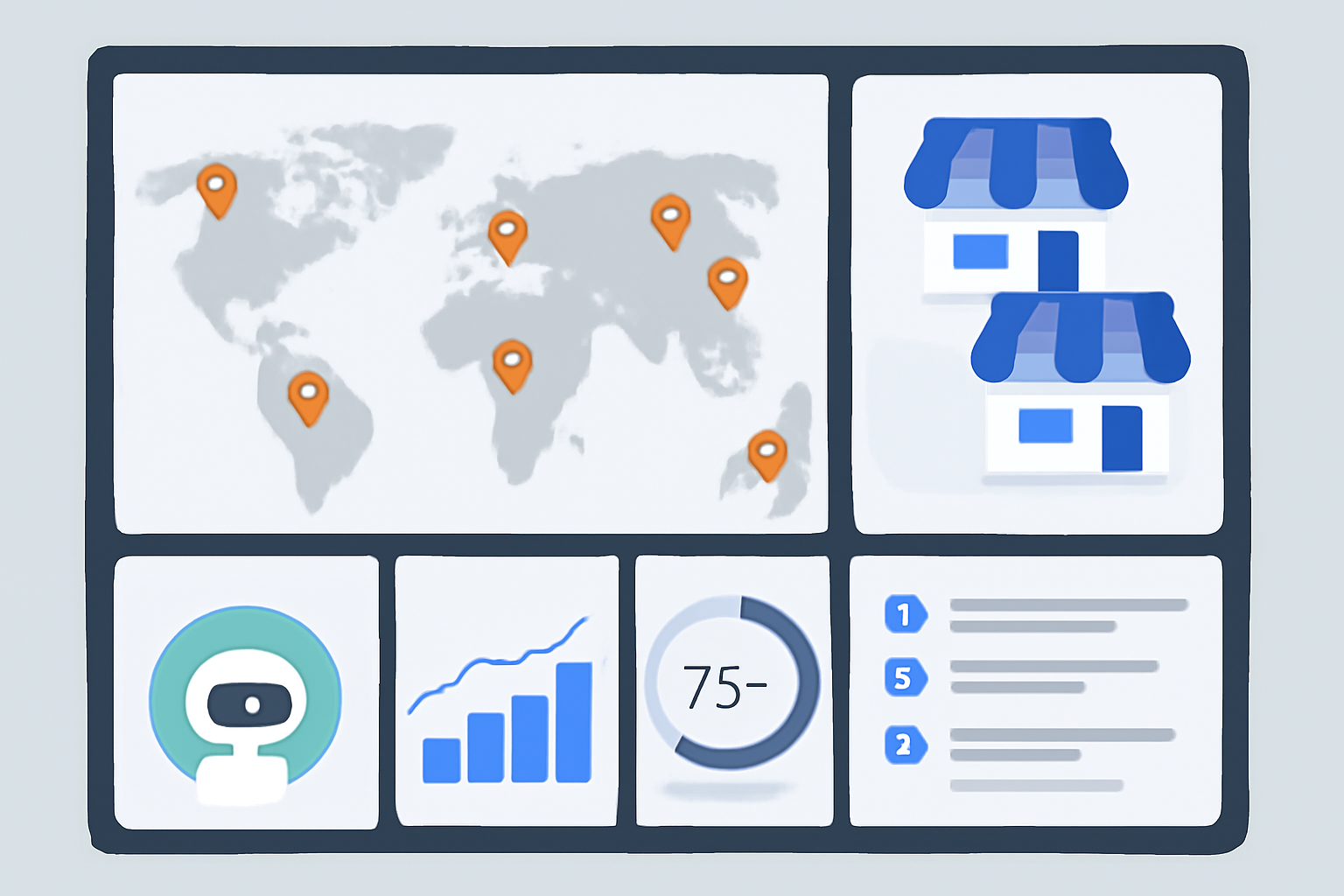
Set up dashboards that combine GBP metrics and site analytics for each cluster to compare performance and spot underperforming locations quickly.
Reusable checklists & templates
GBP Checklist (per location)
- Primary category matches cluster
- Accurate address, phone, hours, and website link
- Services list completed and localized
- At least 10 recent photos uploaded by local staff
- Review request sequence active
Location Page Checklist
- Unique H1 with city/area modifier
- Local schema and geo tags implemented
- Clear CTA(s) mapped to conversion goals
- Internal links to cluster and region pages
- Page performance and mobile checks completed
Frequently Asked Questions
Do I need a Google Business Profile for every location?
Yes — GBP listings act as entity anchors. Each physical location should have its own verified profile unless you operate a service-area business without a storefront.
How do I avoid duplicate or virtual-office issues?
Use precise addresses, consistent phone numbers, and verify ownership via bulk verification when possible. Avoid using shared or virtual addresses that could trigger filtering.
Can AI write my location pages and responses?
AI is useful for drafting and auditing at scale but always include human review to ensure accuracy and local relevance.
Which metrics should I prioritize first?
Start with GBP-driven conversions (calls, direction requests, website actions) and revenue per location. Then layer in visibility and reputation metrics.
What’s the biggest mistake multi-location brands make?
Treating all locations the same. Local differences in services, categories, and prominence require distinct signals for each storefront.
Conclusion
Multi-location local SEO is a systems challenge: model entities, standardize clusters, scale GBP operations, use AI for efficiency, and maintain local authenticity with unique pages, reviews, and local links. Establish measurable KPIs and repeatable playbooks so you can diagnose and improve performance across your footprint.
Need help building a scalable local SEO program or want a locations audit and reusable templates? The Next Zeros helps brands and agencies implement multi-location strategies that drive local visibility and conversions. Contact our team to get a tailored audit and playbook.